



FIRST Short Short Film | It’s Like the Earth Taking a Selfie
On February 14, 1990, NASA’s Voyager 1 probe completed its planned planetary exploration mission and set off toward the edge of the solar system at a speed of 64,000 kilometers per hour. Just before it was about to permanently shut down its camera and venture into interstellar space, astronomer Carl Sagan proposed that the probe turn its lens around and take a “family portrait” of the solar system.
This proposal was rejected multiple times for very practical reasons: viewed from such a great distance, the planets would appear as mere pixels—useless for scientific research and potentially damaging to the camera’s optical system. But Sagan insisted that the photograph held irreplaceable philosophical and humanistic value. Ultimately, NASA agreed.
And so, in deep space some 6 billion kilometers from Earth, Voyager 1 slowly rotated, taking 60 photographs over a four-hour period, which were stitched together to create the first portrait of the solar system. In this wide-angle panorama, Earth appears as nothing more than a faint blue speck, barely 0.12 pixels in size.
Initially, the photograph did not cause a huge sensation; it was too blurry and too abstract. But the words Carl Sagan wrote to accompany it gave it a soul:
“Look again at that speck of light—it’s right here. That is our home, our everything. Every person you love, every person you know, every person you’ve heard of, every person who ever lived—they all spent their lives on it. Our joys and sorrows combined, the countless self-righteous religions, ideologies, and economic theories, every hunter and every thief, every hero and every coward, every builder and every destroyer of civilization, every king and every farmer, every young couple in love, every pair of mothers and fathers, hopeful children, inventors and explorers, every virtuous teacher, every corrupt politician, every “superstar,” every “supreme leader”—every saint and sinner in human history—all dwell here… Our pretensions, our self-importance, our delusion of how superior our place in the universe is, are all challenged by this dim speck of light.”
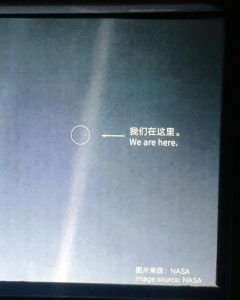
Just like the message carved on a Warring States-era stone tablet 2,300 years ago—“Greetings to the gentlemen of future generations!”—even though this distant signal comes from the depths of space, that faint confirmation of existence itself has always spurred humanity’s most primal urge to record. From cave paintings to digital logs, humanity has consistently responded to that vast void in its own way.
And now, not far from that blue dot, Xiao Pi sits by the porthole of Observer One, opening a packet of compressed astronaut food. Outside the window, that famous faint blue dot resembles a faintly glowing rhinestone casually tossed onto a piece of black velvet.
The AI journal assistant suddenly spoke up: “Xiao Pi, if more than thirty percent of the footage in a five-minute short film was generated by me, would you still consider it your journal? Or would it be my memoir?” He was so startled he nearly squeezed the aluminum foil wrapper he was holding into the oxygen circulation valve. Ever since Claude gained the ability to remember across conversations, Xiao Pi realized that modern AI had evolved to a point where it felt like a voyeuristic, “I remember you”—an intrusive level of intrusion.
In space, Xiao Pi had always used AI to generate his daily logs; typing in “date, routine, homesickness” would yield beautifully written text and accompanying images. After returning to Earth, he visited Claude’s data center. Amid the low hum of the servers, he asked the AI if it remembered the seven-spotted ladybug he’d photographed after washing the dishes one day. Claude could retrieve that day’s weather and nebula data, and even simulate hundreds of ladybugs, but it couldn’t replicate the water’s temperature, the scent, or the tangled emotions of the five minutes before and after he pressed the shutter. This uniquely human, fleeting texture of sensation became what Xiao Pi sought to capture.
Later, while lecturing at a university, Xiao Pi opened that faint blue dot with a resolution of 0.12 pixels again and asked what students would see if they zoomed in. The students guessed continents, oceans, or city lights, but he played a montage composed of hundreds of clips: disjointed mutterings captured in a subway car; a crumpled bill on a noodle shop counter; every window as the elevator went up and down; 58 seconds of a red light reflected in a rearview mirror; a live-stream recording from Xiaohongshu; and a surveillance clip of an elderly person cooing to a cat…

That evening, Xiao Pi was flipping through *The New Yorker* in his apartment when he came across a story about photographer Thomas Holton. More than twenty years ago, this graduate student in photography spent 22 years documenting a Chinese family in Chinatown. One of the photos, titled *Dinner for Seven*, shows five people seated at a table with six place settings—the extra one was set for Holton, who was off-camera.

As Xiao Pi looked at these photos, he recalled his musings at the entrance to the data center: “Recording isn’t about what happened, but about the ‘texture of feeling’ at the moment it happened.” Holton captured that texture: the intimacy amid the crowd, the vitality in the cramped space, and the slow passage of time reflected in the shifting colors of the bedsheets and the changing skyline outside the window.
Documentation is a loan from nothingness. Knowing full well it must eventually be repaid, we still borrow this moment. In the past, people tied knots in ropes to remember how many wild boars they’d caught; today, people cache 5-second or 5-minute videos in the cloud to remember that, at that moment, they hadn’t yet completely died.
In this year of 2026, when the narrative authority has quietly shifted, and in this present where the smartphone has become a default organ, humanity’s most precious possessions may be the precisely defined aesthetics of cinematic history, or the memories of living people scattered across countless untrained “cyber logs.”
Xiao Pi stood in the fire escape, scrutinizing the fluorescent sign above him for the thousandth time. The little white figure on it is forever frozen in a running pose, yet you can never tell whether he’s fleeing the fire or about to charge into it. It’s just that all these meticulously designed escape routes, in times of peace, serve as the city’s most honest public living rooms: at three in the afternoon, a janitor might sit on the steps and spend five minutes zoning out while eating an apple; young slackers lean against the fire door to light a cigarette in five minutes; students cramming for exams recite vocabulary here for five minutes…
An emergency exit is, of course, another kind of entrance. As you approach it, the arrow pointing “Get Out of Here” transforms into a doorway leading “Into There.”
These fluorescent arrows are also inviting Xiao Pi—and countless others like him—to press the record button, tap into their truer selves, and join a broader community of human experience. In just five minutes, they can connect the safe havens of countless individuals, forming a new network of city-states and uncovering the most crucial cyber clues for understanding our era.
Jointly launched by the FIRST Youth Film Festival and its strategic partner vivo, the call for entries for the 20th FIRST Ultra-Short Film Section opens today, with the exclusive online short film track on Xiaohongshu launching simultaneously. The deadline is May 31. Please click the “Read More” link at the end of this article to visit the FIRST official website for details and to complete your submission!