


FIRST UNTITLED Call for Entries Now Open | Synthetic Intimacy
It responded perfectly.
So perfectly that, for a moment, you forgot it was a machine.
Then you suddenly realized that it had never truly felt anything.
What does that moment even mean?
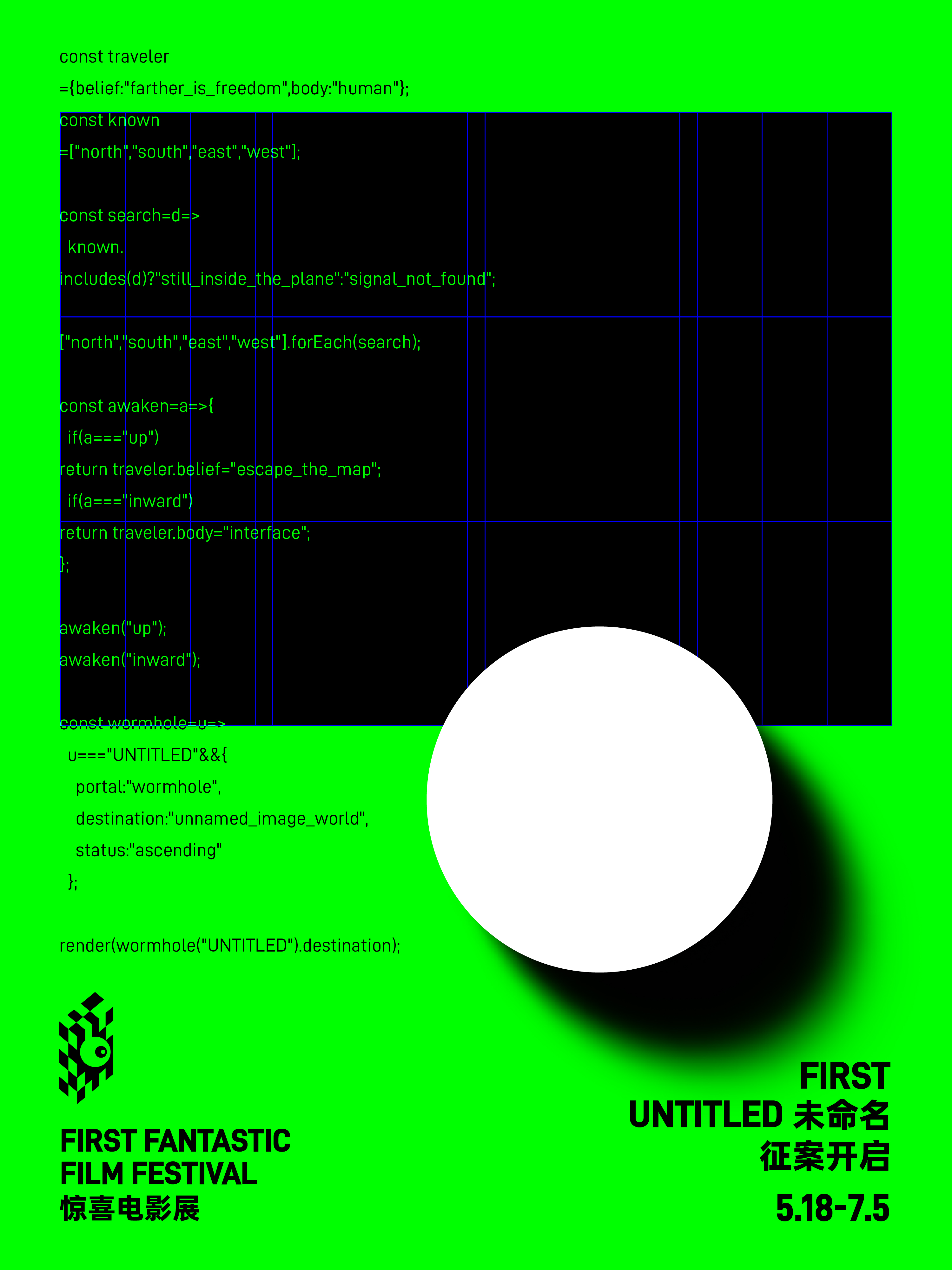
const wormhole=u=>u===”UNTITLED”&&{portal:”AI_wormhole”,destination:”unnamed_image_world”,status:”ascending”};render(wormhole(“UNTITLED”).destination);
It is now 2026, ten years and five months since filmmaker Bennett Miller released his last feature film, and twelve years since he won the Palme d’Or for Best Director at Cannes. In 2024, he began exhibiting his AI-generated works at the Gagosian Gallery in Paris. He personally wrote detailed and precise text prompts and used DALL-E to repeatedly refine and adjust the generated images. To complete the twenty works ultimately exhibited, he generated a total of over 100,000 images. Even though Benni Miller views AI as merely a creative tool, he admits that he has devoted himself entirely to the process, reveling in the experience of exploring uncharted creative territory.
If the camera marked the beginning of visual creation in the 20th century, then today, a single line of text has become the origin of imagery in the new era, using language to sketch and construct countless audiovisual worlds that have never actually existed.
When photography first emerged in the late 19th century, it was not regarded as a legitimate medium for artistic creation, but merely a practical tool that captured fleeting moments of reality through the manipulation of light and shadow. Over time, from the Lumière brothers’ use of the lens to construct visual narratives to today’s increasingly mature and diverse audiovisual creations, photography has firmly established itself in the realm of art, becoming a vital means for creators to express themselves and realize their artistic visions.
Turning our gaze to the present—the latter half of the 2020s—creative commands are constantly issued on screens, and progress bars advance step by step: 31%… 66%… 100%, giving rise to vivid, dynamic imagery. At this moment, images captured through physical lenses converge once more with those named by words; boundless imagination, supported by technology, is transformed into creative momentum with tangible productive power.
More than half of China’s internet users have grown accustomed to expressing their demands and sharing their thoughts on various generative platforms. As AI learns to interpret verbal commands based on human experience, enabling virtual filming, the construction of audiovisual scenes, and the simulation of human emotions and thoughts, a series of fundamental questions about the industry’s very nature arise: Who, exactly, is the true creator of these visual works? How can we be convinced by a scene that has been fabricated by technology? And where exactly do the genuine emotions and resonances we feel within ourselves originate?
Faced with these three defining questions of our era—authorship, embodiment, and the boundaries of emotion—for which there are currently no standard answers, UNTITLED has consistently upheld its core philosophy of “refusing to define.” We sincerely invite creators with a passion for exploration to join us. Leveraging diverse cutting-edge creative tools—including AIGC generation technology, game engines, and interactive design—we will delve into the infinite possibilities hidden between creative prompts and visual generation, working together to discover the unique creative answers that belong to this era.
Even though Chinese-American science fiction writer Ted Chiang maintains that AI lacks the genuine intent required to support creators’ decisions, tens of millions of people remain deeply attached to it. As AI learns to simulate emotions and perceptions and accurately anticipate human needs before they are even voiced, the relationship between artificial intelligence and humans is becoming increasingly complex and ambiguous.
Thus, we look forward to more creators stepping out of their perfect emotional detachment to face, alongside us, the uncomfortable silences, the unpredictable misunderstandings, and the differences that grow through friction and collision—the fragile yet precious undertones of expression found in creation. We also look forward to more viewers who no longer merely watch, but seek to enter the work, achieving a more intimate presence through interaction.
In an era where everything can be generated, the spectacle is nothing more than a tired trick of the past. How many times was the prompt repeated? What glitches occurred during image generation? What happened to the AI and the viewer during the time spent seated in the dark space? What intersected?
Everything remains unnamed, perpetually in progress.
wormhole(“UNTITLED”).status = “still_ascending”;